

From August 23 to 27, 2026, a delegation of 25 undergraduate students from the School of Materials Science and Engineering at Zhejiang University (ZJU) participated in a five-day academic exchange program in Singapore. Led by Professor Jie Jiang and Tianyun Han, Secretary for International Affairs, the delegation visited Nanyang Technological University (NTU), the National University of Singapore (NUS), and the Agency for Science, Technology and Research (A*STAR), gaining firsthand insights into advanced materials research, interdisciplinary innovation, and international academic opportunities.
NTU: Exploring Flexible Sensing and Intelligent Applications
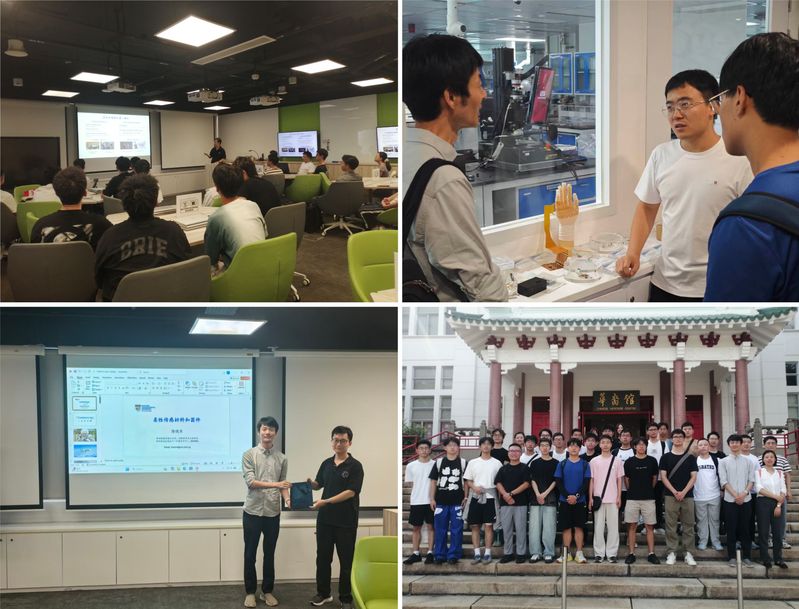
On August 24, the delegation visited NTU's School of Materials Science and Engineering, ranked third globally in Materials Science in the 2026 QS World University Rankings by Subject. PhD students from Professor Xiaodong Chen's research group introduced advances in flexible sensing materials and their applications in healthcare, smart agriculture, and assistive technologies.
During laboratory visits, students explored how materials research translates into practical applications, including humanoid robots and bionic hands. ZJU alumni studying at NTU also shared their experiences of postgraduate applications, academic research, and student life in Singapore.
NUS: Discovering Intelligent Sensing and Sustainable Energy Materials
On August 25, the delegation visited NUS, ranked second globally in Materials Science in the 2026 QS World University Rankings by Subject. At the Lab for Intelligent Sensing, Harvesting and Actuation (LISHA), PhD students from Professor Changsheng Wu's group introduced research on physiological monitoring, neuromuscular intelligence, and human–robot interaction. Demonstrations of advanced sensing technologies, including bioabsorbable microneedle patches, battery-free wireless sensing systems, and three-dimensional mesoscale sensors, highlighted the integration of materials science with intelligent healthcare.
In the afternoon, students visited Professor Hui Ying Yang's research group, where PhD students presented their work on advanced battery technologies, seawater desalination, and battery recycling. The visit provided insights into the role of materials innovation in addressing challenges related to energy storage and environmental sustainability.

A*STAR: Exploring AI-Driven Scientific Research
Also on August 25, the delegation visited A*STAR, Singapore's leading public-sector R&D agency. Dr. Qiang Zhu, head of the Department of Advanced Characterisation and Instrumentation, introduced the growing role of artificial intelligence in scientific discovery, highlighting applications in AI-assisted research and robotic laboratory automation. Students toured research facilities equipped with thin-film deposition, photolithography, and advanced characterization instruments, including transmission and scanning electron microscopes. An interactive discussion explored the opportunities and challenges of integrating AI and robotics into scientific research, encouraging students to reflect on the evolving relationship between human creativity and intelligent automation.

Beyond the Laboratory: Exploring Singapore's Cultural Heritage
Beyond academic exchanges, the delegation visited the Asian Civilisations Museum, exploring exhibitions on maritime trade, cultural beliefs, and decorative arts. The visit offered students a broader perspective on the historical connections among Asian civilizations and encouraged cross-cultural understanding alongside their scientific exploration.
Broadening Academic Horizons
The five-day program provided students with valuable exposure to Singapore's advanced research infrastructure, interdisciplinary academic environment, and innovative research culture. Through laboratory visits, academic discussions, and interactions with researchers and ZJU alumni, students deepened their understanding of emerging materials technologies while gaining new perspectives on postgraduate studies, future research directions, and international academic opportunities.
The exchange also fostered academic connections and reflected ZJU's commitment to broadening students' global perspectives through international engagement.
(Thanks to Xinyi Yao for the contribution to this article)

